Om Second Heart
You are the director of a biotech organization running covert operations to bend global politics and markets to your advantage. You never set foot in the field. You engineer the agents who do.
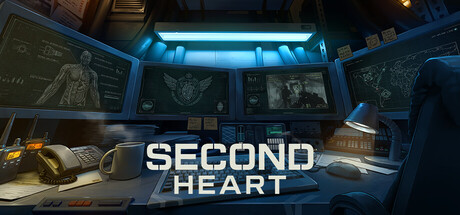
It is a hardcore management sim, played entirely from the control desk. Take the contracts, arm squads and deploy them into conflicts around the world. Then watch the operation unfold live on the feed wall: through your agents' eyes and tactical displays.
Every body has a heart, lungs, kidneys and other organs, each simulated in its own place under the skin. Every bullet destroys exactly what it hits, and what it hits stops working at once. A round through the chest is not a number off a bar. It is a specific organ, gone.
THE FEED WAL
These are not security cameras. Every feed is an agent's own grafted eyes, so their breathing, their flinches and their injuries are in the picture. When one goes down, their feed goes dark.
Work arrives with terms, a manifest, a fee and risk level your broker will admit to. Sweeps, holds, snatches and hits. A corporate tower in Shanghai, an evening walk along a seawall in Rio. Offers expire. Jobs relist. Leads go cold. Pick your squad, or field two when the site calls for it, and decide when they go. The dropship flies in real time, and day becomes night while your agents are in the air.
Combat is automatic. You do not aim and you do not push units around a map. Your agents take cover, suppress and fight on their own, with the bodies and the loadout you gave them. When it turns, multiple courses of action go up on the wall. One call, no take-backs. Then you watch what it bought.
THE LAB
A wounded agent comes home to your surgical theater. Open the body across 14 anatomical zones. Replace damaged organs with whatever the next job demands. Later, print custom grafts from biological templates and push your team past the human limits: a cortex that flags a threat before the eyes resolve it, a blade grown along the forearm bone, a skin that makes a motionless body all but disappear.
A vast library of grafts can be researched and recovered in the field. Every one is living tissue, drawing on the host’s circulation, respiration, innervation, clearance and metabolism. There is a hard limit to what the body can tolerate, and every surgery takes days to recover from.
Build the body you need. Then find out what it can survive.
THE ARMORY
What stands between a bullet and an organ is a plate. Vest and helmet, replaceable, each wearing out on its own. A plate does not absorb a percentage, it defeats a velocity: the vest that shrugs off every sidearm is paper against a rifle. And a plate that holds still passes the blow through — stopped is not unharmed. They come home cracked, and the bench bills you for replacements.
Weapons are a spread, not a progression. Nothing you buy or bring home is simply better than what came before. The suppressed SMG trades range for stealth, the shotgun dominates a single doorway, and the armor-piercing rifle is worse than a cheaper one at everything except defeating a plate. Ammunition is stocked by calibre rather than weapon, so two rifles chambered for the same round draw from the same supply.
THE SALVAGE
Something worth taking usually turns up mid-operation. Sending someone for it costs you noise. At the debrief you decide what came home and what stayed behind: a trophy weapon, a graft pattern nobody else has on file or an injured agent.
The real cost is what you left behind. Bodies. Wreckage. Witnesses. Wounds no forensics lab has a catalog entry for. Someone is watching the pattern. A clean operation isn't just one where everyone comes home — it's one nobody can prove happened.
THE ORGANIZATION
You start with two agents and one contract on the board. Everything after that is your doing: a roster built from walk-ins and people bought out of worse jobs, bodies rebuilt to specifications nobody else can match, a service record written by the weapons each agent actually carried.
A tower changes hands because four people were on a particular floor at a particular hour. A currency moves because somebody did not arrive at a meeting. None of it is ever traced back to the desk, and none of it would have happened without one.
Reach everywhere. Never leave the room.

 Ej släppt