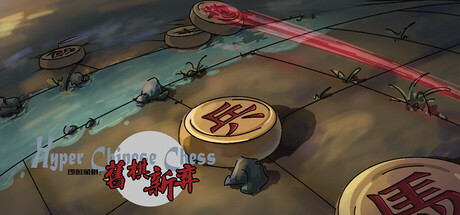
Turn-based play is central to Chinese Chess. HyperChineseChess removes this rule—battle AI or players in real-time, using quick thinking to win. Experience classic chess reimagined!
Numero di giocatori e Steam charts di 即时象棋:旧棋新弈 Hyper Chinese Chess
in tempo reale
Numero di giocatori0— in 24 h
Picco di giocatori 24 h0Rilevazione più alta di oggi
Picco di giocatori 30 gg0Media —
Picco storico di giocatori0Dall'inizio delle rilevazioni
Ore di gioco 30 gg—Stima
Steam chart · giocatori 30 ggin attesa di rilevazioni
Raccolta rilevazioni giornaliere in corsoPer questo gioco non ci sono ancora rilevazioni giornaliere. La curva comparirà non appena saranno disponibili i primi giorni di dati.
Prezzo attuale1,99€Nessuno sconto al momentoMinimo rilevato1,99€22 set 2026 – oggiUltima variazione1,99€22 set 2026Sconti rilevati022 set 2026 – oggi
Compatibilità e funzionalità
WindowsNessun supporto per i controller indicato
Modalità di giocoMulti-playerOnline PvPPvPSingle-player
Funzionalità di SteamFamily SharingSteam Achievements
Accessibilità e audioAdjustable DifficultyCustom Volume ControlsMouse Only Option
AltroTouch Only Option
Requisiti di sistema
MinimiConsigliatiSistemaWindows 7 SP1+ (64-bit)Windows 11 (64-bit)CPUIntel/AMD 2-cores 2.0 GHzIntel/AMD 4-cores 3.0 GHzGPUIntel HD Graphics 4000NVIDIA GeForce GT 1030RAM2 GB RAM4 GB RAMSpazio su disco500 MB available space800 MB available space
Informazioni su 即时象棋:旧棋新弈 Hyper Chinese Chess
Tired of traditional Chinese Chess? HyperChineseChess: Real-Time Battle – A Classic Reborn offers a fresh take! Face off against AI or challenge friends in real-time chess warfare. For extra thrills, try the Fog of War mode—where hidden moves intensify the clash!
In traditional Chinese Chess, players should obey the rules below.
The board consists of 9 horizontal and 10 vertical lines, divided by a "River" in the middle. Each side has a "Palace" (3×3 square with diagonal lines) at the center of the baseline.
32 pieces in total (16 per side): 将/帅 (General/King) ×1, 士 (Advisors) ×2, 相/象 (Elephants) ×2, 马 (Horses) ×2, 车 (Chariots) ×2, 炮 (Cannons) ×2, 兵/卒 (Soldiers/Pawns) ×5.
Red moves first, players alternate turns. Soldiers/Pawns cannot move backward.
The General (Black) or King (Red) is the core piece and can only move one square at a time (horizontally or vertically) within the Palace (3×3 grid).
Advisors move one square diagonally per turn and are confined to the Palace. They cannot step outside the Palace or move orthogonally.
Horses move like knights in chess (one square straight + one square diagonal). If the adjacent square in the initial direction is occupied ("hobbling the horse's leg"), the move is blocked.
Chariots move any number of squares horizontally or vertically (like a rook in chess), but cannot jump over pieces.
Cannons move like Chariots, but to capture, they must jump over exactly one intervening piece (called a "screen"). Without a screen, they cannot attack.
Soldiers move one square forward before crossing the River. After crossing, they can move sideways or forward, but never backward.
And this dynamic variant transforms traditional Chinese chess into an exciting real-time strategy game.
Players compete not in turns, but through continuous action point management. Each player gains 1 action point (AP) every second, stored up to a maximum of 4 AP. Every piece movement costs 1 AP, creating strategic decisions about when to save points and when to execute rapid maneuvers.
The core objective remains unchanged - checkmate the opponent's General. However, the real-time element introduces thrilling new dynamics. Players might choose to immediately spend AP on aggressive moves, or strategically save points for powerful combinations. The Cannon becomes particularly deadly when players accumulate enough AP to move and fire in quick succession.
All traditional movement rules apply: Generals stay within their palaces, Horses jump in L-shapes (unless blocked), Chariots roam freely, and Cannons require screens for captures. Soldiers gain mobility after crossing the river, but still cannot retreat. The key innovation is that players may move any piece at any time when they have AP available, leading to simultaneous actions and intense tactical exchanges.
Victory is achieved through the classic checkmate condition, but now under the pressure of real-time decision making. The AP system creates natural ebbs and flows in the game's tempo, rewarding both quick reflexes and long-term planning. Players must balance offense and defense while efficiently managing their precious action points in this fast-paced chess battle.
Domande frequenti
即时象棋:旧棋新弈 Hyper Chinese Chess costa 1,99€ sul negozio di Steam (DE). Il prezzo più basso che abbiamo rilevato da quando lo monitoriamo (22 set 2026) è 1,99€. Steam applica al gioco prezzi diversi in 14 regioni: i prezzi regionali sono elencati più in alto.
上弦月工作室AscentGames ha lanciato 即时象棋:旧棋新弈 Hyper Chinese Chess il giorno 6 novembre 2025. Uscito 11 mesi fa.
Requisiti minimi: Windows 7 SP1+ (64-bit), Intel/AMD 2-cores 2.0 GHz, Intel HD Graphics 4000, 2 GB RAM. La scheda dei requisiti qui sopra mette a confronto i requisiti minimi e consigliati per ogni piattaforma.
Steam indica 500 MB di spazio libero su disco per 即时象棋:旧棋新弈 Hyper Chinese Chess. I requisiti consigliati ne richiedono 800 MB.
Recensioni positive su Steam: 79,3% su un totale di 58. Il giudizio complessivo di Steam è «Mostly Positive».
No, Steam non elenca l'italiano tra le lingue di 即时象棋:旧棋新弈 Hyper Chinese Chess. In totale Steam elenca 1 lingua, nessuna delle quali con audio completo.
Sì, Steam elenca queste modalità per 即时象棋:旧棋新弈 Hyper Chinese Chess: PvP online.
Le Steam charts di 即时象棋:旧棋新弈 Hyper Chinese Chess su SteamStatistics mostrano il numero di giocatori in tempo reale e le curve delle ultime 24 ore, 7 giorni e 30 giorni, aggiornate almeno ogni dieci minuti.
Su Steam, 即时象棋:旧棋新弈 Hyper Chinese Chess funziona su Windows. Nessun supporto per i controller indicato.
Classificazione di 即时象棋:旧棋新弈 Hyper Chinese Chess: DEJUS 6 e IGRS 3.

 Posizione #116297