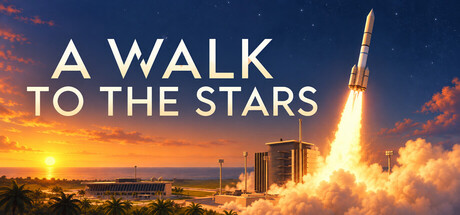
A Walk to the Stars is exactly what it says: a walk… to the stars. Sit back in your chair, relax, and enjoy watching your very first rocket leave the ground. Learn how it works, then, step by step, leave Earth behind, find your way around near space, and finally set out for deep space.
A Walk to the Stars: Spielerzahlen & Steam-Charts
live
Spielerzahl—— in 24 Std.
Peak 24 Std.0Höchster Messwert heute
Peak 30 Tage0Ø —
Allzeit-Peak0Seit Beginn der Erfassung
Spielstunden 30 Tage—Geschätzt
Steam-Chart · Spielerzahl 30 Tagewarte auf Messwerte
Tägliche Messwerte werden gesammeltFür dieses Spiel sind noch keine täglichen Messwerte gespeichert. Die Kurve erscheint, sobald die ersten Tage Historie vorliegen.
24 Stunden—7 Tage—TrendStabil
Reviews0 Reviews
—No user reviews
0 positiv0 negativ
Empfehlungen—Score0/9
Letzte 30 Tagekeine DatenAnteil negativ—Positiv je negativ—
Medien
10 Bilder
Spieldetails
Über das Spiel
Spiel
Erscheinungsdatum—Erscheinungsdatum nicht angekündigt
A Walk to the Stars is exactly what it says: a walk… to the stars. Sit back in your chair, relax, and enjoy watching your very first rocket leave the ground. Learn how it works, then, step by step, leave Earth behind, find your way around near space, and finally set out for deep space.
This is not a heavy management game, nor a hardcore simulator. It is a walk: every shot is meant to be a painting, every launch a moment to take in.
A real solar system
The solar system in A Walk to the Stars is not a backdrop. The Sun, the planets and their moons move along their real orbits, computed from real astronomical data, at their true scale. The sky above the launch pad is the real sky.
Your rockets obey the same laws. Every launch is computed from the rocket you designed — its mass, its thrust, its stages — and follows a real trajectory, from lift-off to orbit.
Built on real data
- The planets and their orbits — positions computed from NASA/JPL orbital data; the Moon follows JPL Horizons ephemerides (DE441).
- The night sky — NASA Goddard's Deep Star Maps 2020, built from the Hipparcos, Tycho-2 and Gaia star catalogues (ESA).
- The worlds themselves — the Sun, the planets, Earth, the Moon and Saturn's rings from Solar System Scope maps based on NASA data; Phobos and Deimos from the Viking missions.
- The International Space Station — NASA's own 3D model.
- Kourou and French Guiana — the land around the space center comes from Landsat satellite imagery, with coastlines, rivers and lakes from OpenStreetMap.
The road ahead
The journey starts with a program as real as it gets: the first rockets, the first orbits, then the exploration of the solar system. But if the adventure goes on… we'll probably need antimatter or nuclear propulsion to visit Proxima Centauri!
About the developer
A Walk to the Stars is made by a solo developer, with AI tools helping with the models, voices and code.
Häufige Fragen
Steam nennt für A Walk to the Stars derzeit keinen Preis.
A Walk to the Stars ist noch nicht erschienen. Ein Datum wurde noch nicht angekündigt.
Minimum: Windows 10 / 11 (64-bit), Intel Core i3-8100 / AMD Ryzen 3 3100, NVIDIA GeForce GTX 1650 (4 GB) / AMD Radeon RX 570, 8 GB RAM. Die Anforderungs-Karte oben vergleicht Mindest- und empfohlene Anforderungen für jede Plattform.
Steam gibt für A Walk to the Stars 5 GB freien Speicherplatz an.
Für dieses Spiel gibt es noch keine Steam-Reviews.
Nein — Steam listet für A Walk to the Stars keine deutsche Sprachversion. Insgesamt listet Steam 2 Sprachen, 2 mit Sprachausgabe.
Nein — Steam führt A Walk to the Stars als Singleplayer-Spiel.
Die Steam Charts von A Walk to the Stars auf SteamStatistics zeigen die aktuelle Spielerzahl und die Verläufe über 24 Stunden, 7 und 30 Tage — mindestens alle zehn Minuten aktualisiert.Steam Charts von A Walk to the Stars öffnen ›
Auf Steam läuft A Walk to the Stars unter Windows. Keine Controller-Unterstützung angegeben.
A Walk to the Stars hat die Altersfreigabe DEJUS L.

 Unveröffentlicht