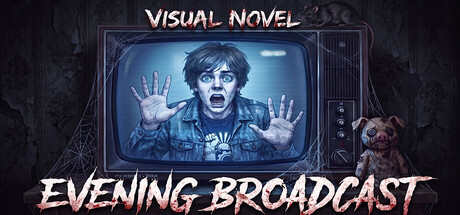
Late evening in 1989. A student receives an old Soviet television with one warning: "Don't watch it in the evening. Anyone watching in the dark remains inside."
Visual Novel: EVENING BROADCAST 在线人数与 Steam 图表
实时
在线人数024 小时 —
24 小时峰值玩家2今日最高样本
30 天峰值玩家2平均 2
历史峰值玩家2自开始追踪以来
30 天游玩时长26估算值
Steam 图表 · 30 天在线人数等待采样
正在收集每日样本目前只有一天的历史数据——曲线至少需要两个样本。
24 小时—7 天—趋势持平
评测12 篇评测
91.7%Positive
11 篇好评1 篇差评
推荐数—评分
媒体
21 张图片
游戏详情
关于这款游戏
游戏
发行日期2026年9月19日6 天前发行
开发者Reanim Games发行商STuNT类型动作冒险独立角色扮演休闲
—成就
关于这款游戏
玩家数更新于 9月19日 20:31 UTC · 商店数据更新于 9月22日 21:08 UTC · 来源:SteamWebAPI
辅助功能与音频Mouse Only OptionPlayable without Timed InputSave Anytime
更多Playable At Your Own Pace
系统需求
最低配置推荐配置系统64-bit Windows 10—处理器Intel Core i5-3570K or AMD FX-8310—显卡GeForce GTX 670 / GeForce GTX 1050 / AMD Radeon HD 7870—内存8 GB RAM—存储空间700 MB available space—
关于 Visual Novel: EVENING BROADCAST
1989. Yura Laptev, a student at a technical institute, receives an old television from a mysterious old man. The old man gives one warning: "Don't watch it in the evening. Anyone watching in the evening remains inside."
Yura ignores the warning. In the evening, he turns on the television—and finds himself trapped.
Now he finds himself inside the screen, in a world of static and forgotten television studios. Around him is a labyrinth of abandoned Soviet television studios, once bustling with life. Then the airwaves were shut down. The programs were forgotten. But they didn't disappear—they remained inside. Waiting. Hungry.
Ten Meetings, Ten Choices
Yura understands: to escape, he must go through all the studios. But each meeting is a test. Each presenter plays their own game. Each has their own rules, their own logic, their own understanding of how the world works.
And in every studio, there's a choice. To act or to refuse. To believe or to doubt. To watch or to close your eyes. To join the game or to stand aside.
The wrong choice—and Yura will remain here. To become part of the show. An eternal spectator or an eternal actor.
The Logic of Survival
It's not about strength or dexterity. It's about understanding people. Understanding what they want. Why they're desperate. Where their weaknesses lie.
Every encounter is a puzzle. Sometimes the solution is to act. Sometimes it's to refuse. Sometimes it's simply to look into their eyes and not look away. Sometimes it's to leave, not playing at all.
Every choice has consequences. Every ending tells a story.
Every studio is a place of silent melancholy. Every presenter was once needed. Now they're static.
Psychological horror through dialogue—Characters don't scream or attack. They persuade, manipulate, and play with words. Every phrase can become a trap or a salvation.
GAME FEATURES
A choice system with irreversible consequences — Every decision carries weight. The wrong word, the wrong look, the wrong refusal — and you're trapped inside forever. No second chances in a single playthrough.
Multiple trap endings — Dozens of different bad endings, each showing how you become part of the broadcast. Each has its own logic and horror.
Changing studios and atmospheres — From the silence of static to cardboard sets, from icy walls to sticky floors, from empty chairs to mirrored reflections. Each location creates a new trap.
One night, one story — A complete journey from turning on the TV to either exiting or dissolving into static. A coherent story that can be completed in a single evening and replayed for different endings.
Choices based on understanding — There are no right answers, only logical ones. You must understand why each character is desperate, what they want, and where their weakness lies. The solution comes not from action, but from reflection.
WARNING
The game contains intense psychological horror with themes of imprisonment, manipulation, and loss of identity; scenes of deformation and transformation of the human body, including graphic images of human organs; threats of surgical intervention without anesthesia; scenes of suffocation by steam and suffocation; hanging from a trapeze; tying with ribbons and ropes; death by hypothermia and burns; deformed and disfigured characters with inhuman features; disturbing scenes involving food; characters turning into parts of a television broadcast; themes of oblivion, loneliness, and inability to escape; a claustrophobic atmosphere and a feeling of confinement.

 排名 #130325