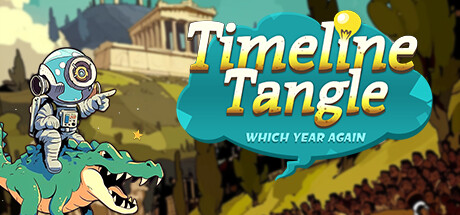
"Timeline Tangle: Which Year Again" is a card game that combines historical knowledge and strategic gameplay. Players will play the role of a time and space weaver who travels through the long river of history.
Timeline Tangle:Which Year Again 在线人数与 Steam 图表
实时
在线人数—24 小时 —
24 小时峰值玩家0今日最高样本
30 天峰值玩家0平均 —
历史峰值玩家0自开始追踪以来
30 天游玩时长—估算值
Steam 图表 · 30 天在线人数等待采样
正在收集每日样本尚未存储该游戏的每日样本。积累最初几天的历史数据后,曲线就会出现。
24 小时—7 天—趋势持平
评测0 篇评测
—No user reviews
0 篇好评0 篇差评
推荐数—
媒体
5 张图片
游戏详情
关于这款游戏
游戏
发行日期—发行日期未公布
开发者WuL Game Studio发行商WuL Game Studio类型免费开玩策略独立休闲
—成就—
关于这款游戏
玩家数更新于 — · 商店数据更新于 9月23日 01:48 UTC · 来源:SteamWebAPI
最低配置推荐配置系统win 10(64bit)相同处理器Intel Core i3 / AMD Ryzen 3相同显卡GTX 650Ti / HD 6850相同内存2 GB RAM相同存储空间2 GB available space相同
关于 Timeline Tangle:Which Year Again
"Timeline Tangle: Which Year Again" is a card game that combines historical knowledge and strategic gameplay. Players will play the role of a time and space weaver who travels through the long river of history. They use the historical event cards in their hands to arrange them in the correct chronological order to complete a series of level challenges. The game not only tests the player's understanding of historical events, but also exercises the player's memory and logical thinking ability.
Game rules:
1. Preparation for the start:
At the beginning of each game, the player will get a certain number of cards, which represent different historical events or characters.
The player has a certain amount of initial power to bear the penalty for wrong sorting (that is, not arranging the cards in chronological order) (the penalty is to deduct a certain amount of power).
At the beginning of the game, there are already some cards in the table card area arranged in chronological order.
2. Game goal:
The goal is to put all the cards in the table card area in the correct historical time order (that is, arranging the cards in chronological order) (there is already a public card area with cards at the beginning of the game, and these cards represent different historical events or characters).
3. Game process:
Players check the historical events or characters on the cards and place them in the corresponding positions on the desktop according to the time of their occurrence.
If placed correctly, the card will be fixed on the desktop and cannot be moved.
If placed incorrectly, the player will be deducted a certain amount of power, and the card will be discarded (that is, the card can no longer be used in this game), and the player needs to draw a new card from the deck to add to the hand.
Players can check their remaining power and number of cards at any time.
4. Victory and failure conditions:
When all cards are correctly placed on the desktop, the player wins and can get rewards such as fragments, silver coins and gold coins.
If the player's power is deducted to 0, the game fails and no rewards will be received for this challenge.
Game mechanism details:
Historical cards: Each card will be marked with the key years of specific events or characters. Players need to decide where to place the cards according to the order of the years.
Power system: Power represents the player's tolerance for error. Each incorrect placement of a card will reduce the power. When the power is exhausted, the game ends.
Reward mechanism: After successfully completing the game, players can obtain fragments, silver coins, and gold coins. These resources can be used to unlock more cards or purchase in-game items.

 未发行免费开玩