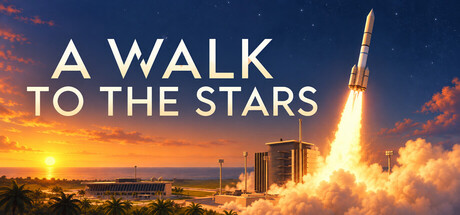
A Walk to the Stars is exactly what it says: a walk… to the stars. Sit back in your chair, relax, and enjoy watching your very first rocket leave the ground. Learn how it works, then, step by step, leave Earth behind, find your way around near space, and finally set out for deep space.
A Walk to the Stars player count & Steam charts
live
Player count—— in 24h
Peak players 24h0Highest sample today
Peak players 30d0Avg —
All-time peak players0Since tracking began
Hours played 30d—Estimated
Steam chart · player count 30dawaiting samples
Collecting daily samplesNo daily samples stored for this game yet. The curve appears once the first days of history are in.
A Walk to the Stars is exactly what it says: a walk… to the stars. Sit back in your chair, relax, and enjoy watching your very first rocket leave the ground. Learn how it works, then, step by step, leave Earth behind, find your way around near space, and finally set out for deep space.
This is not a heavy management game, nor a hardcore simulator. It is a walk: every shot is meant to be a painting, every launch a moment to take in.
A real solar system
The solar system in A Walk to the Stars is not a backdrop. The Sun, the planets and their moons move along their real orbits, computed from real astronomical data, at their true scale. The sky above the launch pad is the real sky.
Your rockets obey the same laws. Every launch is computed from the rocket you designed — its mass, its thrust, its stages — and follows a real trajectory, from lift-off to orbit.
Built on real data
- The planets and their orbits — positions computed from NASA/JPL orbital data; the Moon follows JPL Horizons ephemerides (DE441).
- The night sky — NASA Goddard's Deep Star Maps 2020, built from the Hipparcos, Tycho-2 and Gaia star catalogues (ESA).
- The worlds themselves — the Sun, the planets, Earth, the Moon and Saturn's rings from Solar System Scope maps based on NASA data; Phobos and Deimos from the Viking missions.
- The International Space Station — NASA's own 3D model.
- Kourou and French Guiana — the land around the space center comes from Landsat satellite imagery, with coastlines, rivers and lakes from OpenStreetMap.
The road ahead
The journey starts with a program as real as it gets: the first rockets, the first orbits, then the exploration of the solar system. But if the adventure goes on… we'll probably need antimatter or nuclear propulsion to visit Proxima Centauri!
About the developer
A Walk to the Stars is made by a solo developer, with AI tools helping with the models, voices and code.
Players updated — · store data Oct 6, 05:15 AM UTC · source: SteamWebAPI
Steam does not list a price for A Walk to the Stars at the moment.
A Walk to the Stars has not been released yet. No date has been announced.
Minimum: Windows 10 / 11 (64-bit), Intel Core i3-8100 / AMD Ryzen 3 3100, NVIDIA GeForce GTX 1650 (4 GB) / AMD Radeon RX 570, 8 GB RAM. The requirements card above compares minimum and recommended specs for every platform.
Steam lists 5 GB of free disk space for A Walk to the Stars.
There are no Steam reviews for this game yet.
English is supported, including full audio. In total, Steam lists 2 languages for A Walk to the Stars, 2 with full audio.
No — Steam lists A Walk to the Stars as a single-player game.
The A Walk to the Stars Steam charts on SteamStatistics show the live player count and the 24-hour, 7-day and 30-day curves, refreshed at least every ten minutes.Open the A Walk to the Stars Steam charts ›
On Steam, A Walk to the Stars runs on Windows. No controller support listed.

 Unreleased