Program three distinct towers with readable visual logic, then solve handcrafted tower-defense puzzles where placement, line of sight and every code block matter. No programming experience required.
Tower.defense(): Program The Fight : nombre de joueurs et Steam charts
en direct
Nombre de joueurs—— sur 24 h
Pic de joueurs 24 h0Mesure la plus haute du jour
Pic de joueurs 30 j0Moy. —
Record de joueurs0Depuis le début du suivi
Heures jouées 30 j—Estimation
Steam chart · joueurs sur 30 jen attente de mesures
Collecte des mesures quotidiennesAucune mesure quotidienne n'est encore enregistrée pour ce jeu. La courbe apparaîtra dès que les premiers jours d'historique seront disponibles.
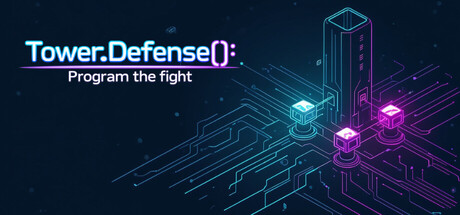
Program the fight.
In tower.defense(): Program the Fight, towers do not decide for you. Place one on the board,
open its controller and build the rule it will follow when the machines arrive.
There is no syntax to type. The visual language introduces conditions, comparisons and logical
choices in plain words, one idea at a time. You can start with “fire at the nearest enemy” and grow
toward compact IF/ELSE behaviours that react to armour, position and pressure.Three towers. Three ways to think.
- Sentry — a direct weapon whose target and ammunition choices matter.
- Lance — a deliberate line shot that rewards timing and alignment.
- Warden — a support controller that scans, marks and slows threats for the rest of the plan.
Each placed tower keeps its own controller. Save a useful program as a blueprint, reuse it elsewhere
and adapt the local copy without destroying the original.The board is part of the code.
Maintenance zones offer real placement choices rather than fixed universal sockets. Elevation can
extend useful reach. Barriers and rooftop structures can break line of sight. A perfect rule in the
wrong position is still the wrong solution.Test it. Understand it. Deploy it.
Run a lab rehearsal to watch a tower's exact decisions. Pause, step and rewind the result, then
inspect why a target was chosen. When the plan says what you mean, deploy it into the live fight.
Clearing the route is only the first result. Protect the relay, respect hardware and block budgets,
and solve without unnecessary live changes to earn the strongest evaluation.Logic puzzles inside a real tower defence.
The campaign is built for people who have never programmed as well as players who enjoy optimizing
a clean solution. SOFIA guides the maintenance channel, but the final behaviour is yours.
- Single-player tower defence driven by visual programs
- Readable IF/ELSE, comparisons and logical operators without typed syntax
- Sentry, Lance and Warden controllers with different tactical roles
- Placement, elevation and line-of-sight puzzles
- Deterministic rehearsals with causal inspection
- Reusable blueprints and per-tower local edits
- Optional hardware and code-block optimization goals
Questions fréquentes
Steam n'affiche actuellement aucun prix pour Tower.defense(): Program The Fight.
Tower.defense(): Program The Fight n'est pas encore sorti. Sortie prévue : 2026.
Configuration minimale : Windows 10 64-bit, Intel Core i5-4460 / AMD FX-6300, GTX 750 / Radeon R7 260X, 4 GB RAM. La fiche ci-dessus compare les configurations minimale et recommandée pour chaque plateforme.
Steam indique 1 GB d'espace disque disponible pour Tower.defense(): Program The Fight.
Ce jeu n'a encore aucune évaluation sur Steam.
Oui — Tower.defense(): Program The Fight propose l'interface et les sous-titres en français, mais sans doublage audio complet. Au total, Steam répertorie 10 langues, dont aucune avec audio complet.
Non — Steam répertorie Tower.defense(): Program The Fight comme un jeu solo.
Les Steam charts du jeu Tower.defense(): Program The Fight sur SteamStatistics affichent le nombre de joueurs en direct et les courbes sur 24 heures, 7 jours et 30 jours, actualisées au moins toutes les dix minutes.
Sur Steam, Tower.defense(): Program The Fight fonctionne sous Windows. Aucune prise en charge des manettes indiquée.
Tower.defense(): Program The Fight est classé DEJUS 6 et IGRS 13.

 Pas encore sorti