She kept the machine that holds the city up. It ran correctly for eleven years, and last night it killed her. Step through her rune-tape, watch the registers, rewind the trace, and name the line that did it. You never write a program. You read one, and you convict it.
Faultfinder : nombre de joueurs et Steam charts
en direct
Nombre de joueurs—— sur 24 h
Pic de joueurs 24 h0Mesure la plus haute du jour
Pic de joueurs 30 j0Moy. —
Record de joueurs0Depuis le début du suivi
Heures jouées 30 j—Estimation
Steam chart · joueurs sur 30 jen attente de mesures
Collecte des mesures quotidiennesAucune mesure quotidienne n'est encore enregistrée pour ce jeu. La courbe apparaîtra dès que les premiers jours d'historique seront disponibles.
24 heures—7 jours—TendanceStable
Évaluations0 évaluations
—No user reviews
0 positives0 négatives
Recommandations—Note0/9
30 derniers joursaucune donnéePart négative—Pos. par nég.—
WindowsAucune prise en charge des manettes indiquée
GameplaySingle-player
Fonctionnalités SteamFamily Sharing
Configuration requise
MinimaleRecommandéeSystèmeWindows 10Windows 10/11CPUAny dual-core processor (2 Ghz+)Any quad-core processorGPUAny GPU with OpenGL 3.3 supportAny GPU with Vulkan or D3D12 supportRAM2 GB RAM4 GB RAMEspace disque500 MB available spaceidentique
À propos du jeu
À propos : Faultfinder
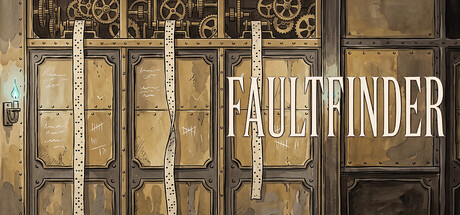
She was the only one who could read it. Now she's dead, and it's still running.
A rune-tape program runs the pressure ward that keeps the Drifted City aloft. It ran correctly for eleven years. Last night it killed the engineer who maintained it.
You have her listing. Her logs. Her stepper.
Find the instruction that did it.
You never write a line of code. You read one.
Faultfinder is a deduction game with a debugger for a magnifying glass. Every case opens as three panes: her annotated listing on the left, the machine's live state in the middle, and on the right what the city actually observed. A pressure reading that held at zero for nine seconds. A door that reported closed while it stood open.
Your tools are a debugger's, not a programmer's:
- Step one instruction and watch exactly one thing change.
- Break on a line, or on a condition: stop when PRESSURE drops below four.
- Watch a register and read its whole history as a strip beside the tape.
- Rewind. The entire trace is recorded. The scrub bar runs both ways.
- Inject a different reading from the outside world and re-run it. Some faults only wake for one input in a thousand.
Then you commit. Name one line. Name one fault from a fixed vocabulary: off-by-one boundary, uninitialised register, wrong branch polarity, overwritten value, unit mismatch, missing bounds check. Then name the moment the harm was done. Get all three right and the report writes itself, one clause at a time.
Every case has exactly one answer. That is not a promise. It is a proof.
Faultfinder's cases aren't designed and playtested into fairness. They're machine-verified before they ship. Each one is built by taking a correct program, applying a single seeded fault, and then proving by exhaustive simulation across the whole input space that the faulty program fails, that reverting that one instruction fixes it, and that no other single change can.
If a case has a second defensible answer, the pipeline rejects it and you never see it. No designer ever adjudicates whether your reasoning was fair. The machine already did.
The program is a character document.
M. VOSK kept this ward for eleven years. She annotated her own tape in pencil, translating each rune for herself in her first year, because nobody had taught her either.
Her glosses thin as the cases go on. Her comments get terser. There is a line she commented out, years ago, with the note leave this.
You are the first person in eleven years to read her carefully. You are eleven years late.
For the specific pleasure almost no game has dramatised
If you have ever written software, you know the feeling of a bug collapsing into obviousness. The moment a mess becomes a sentence. Faultfinder makes that collapse the win condition and puts a body underneath it.
And if you haven't: you don't need to. Nothing here asks you to author anything. The blank page is the wall that keeps most players out of programming games, and this game does not have one. Her handwritten gloss sits beside every rune in the first case. Hover translates anything, always. No case is ever gated on remembering.
In the demo
- Seven cases, 35 to 70 minutes, on one machine: the pressure ward on the city's underside
- A fourteen-instruction rune-tape, taught by using it
- Six classes of fault, each hiding in a different way
- Full rewind, conditional breakpoints, register watches and input injection
- Her story, told entirely in marginalia and log fragments
Wishlist Faultfinder to hear when the full ward opens.
From Endpaper
A solo studio in Somerset. Built in Godot.
Joueurs mis à jour : — · données du magasin : 22 sept., 00:15 UTC · source : SteamWebAPI
Questions fréquentes
Steam n'affiche actuellement aucun prix pour Faultfinder.
Faultfinder n'est pas encore sorti. Sortie prévue : Q4 2026.
Configuration minimale : Windows 10, Any dual-core processor (2 Ghz+), Any GPU with OpenGL 3.3 support, 2 GB RAM. La fiche ci-dessus compare les configurations minimale et recommandée pour chaque plateforme.
Steam indique 500 MB d'espace disque disponible pour Faultfinder.
Ce jeu n'a encore aucune évaluation sur Steam.
Non — Steam n'indique pas de version française pour Faultfinder. Au total, Steam répertorie 1 langue, dont 1 avec audio complet.
Non — Steam répertorie Faultfinder comme un jeu solo.
Les Steam charts du jeu Faultfinder sur SteamStatistics affichent le nombre de joueurs en direct et les courbes sur 24 heures, 7 jours et 30 jours, actualisées au moins toutes les dix minutes.Ouvrir les Steam charts du jeu Faultfinder ›
Sur Steam, Faultfinder fonctionne sous Windows. Aucune prise en charge des manettes indiquée.

 Pas encore sorti