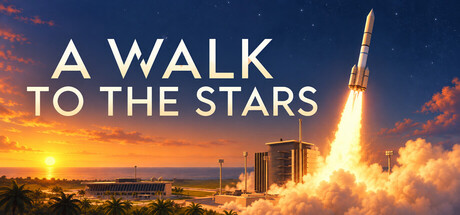
A Walk to the Stars is exactly what it says: a walk… to the stars. Sit back in your chair, relax, and enjoy watching your very first rocket leave the ground. Learn how it works, then, step by step, leave Earth behind, find your way around near space, and finally set out for deep space.
A Walk to the Stars : nombre de joueurs et Steam charts
en direct
Nombre de joueurs—— sur 24 h
Pic de joueurs 24 h0Mesure la plus haute du jour
Pic de joueurs 30 j0Moy. —
Record de joueurs0Depuis le début du suivi
Heures jouées 30 j—Estimation
Steam chart · joueurs sur 30 jen attente de mesures
Collecte des mesures quotidiennesAucune mesure quotidienne n'est encore enregistrée pour ce jeu. La courbe apparaîtra dès que les premiers jours d'historique seront disponibles.
24 heures—7 jours—TendanceStable
Évaluations0 évaluations
—No user reviews
0 positives0 négatives
Recommandations—Note0/9
30 derniers joursaucune donnéePart négative—Pos. par nég.—
A Walk to the Stars is exactly what it says: a walk… to the stars. Sit back in your chair, relax, and enjoy watching your very first rocket leave the ground. Learn how it works, then, step by step, leave Earth behind, find your way around near space, and finally set out for deep space.
This is not a heavy management game, nor a hardcore simulator. It is a walk: every shot is meant to be a painting, every launch a moment to take in.
A real solar system
The solar system in A Walk to the Stars is not a backdrop. The Sun, the planets and their moons move along their real orbits, computed from real astronomical data, at their true scale. The sky above the launch pad is the real sky.
Your rockets obey the same laws. Every launch is computed from the rocket you designed — its mass, its thrust, its stages — and follows a real trajectory, from lift-off to orbit.
Built on real data
- The planets and their orbits — positions computed from NASA/JPL orbital data; the Moon follows JPL Horizons ephemerides (DE441).
- The night sky — NASA Goddard's Deep Star Maps 2020, built from the Hipparcos, Tycho-2 and Gaia star catalogues (ESA).
- The worlds themselves — the Sun, the planets, Earth, the Moon and Saturn's rings from Solar System Scope maps based on NASA data; Phobos and Deimos from the Viking missions.
- The International Space Station — NASA's own 3D model.
- Kourou and French Guiana — the land around the space center comes from Landsat satellite imagery, with coastlines, rivers and lakes from OpenStreetMap.
The road ahead
The journey starts with a program as real as it gets: the first rockets, the first orbits, then the exploration of the solar system. But if the adventure goes on… we'll probably need antimatter or nuclear propulsion to visit Proxima Centauri!
About the developer
A Walk to the Stars is made by a solo developer, with AI tools helping with the models, voices and code.
Joueurs mis à jour : — · données du magasin : 6 oct., 05:15 UTC · source : SteamWebAPI
Steam n'affiche actuellement aucun prix pour A Walk to the Stars.
A Walk to the Stars n'est pas encore sorti. Aucune date n'a été annoncée.
Configuration minimale : Windows 10 / 11 (64-bit), Intel Core i3-8100 / AMD Ryzen 3 3100, NVIDIA GeForce GTX 1650 (4 GB) / AMD Radeon RX 570, 8 GB RAM. La fiche ci-dessus compare les configurations minimale et recommandée pour chaque plateforme.
Steam indique 5 GB d'espace disque disponible pour A Walk to the Stars.
Ce jeu n'a encore aucune évaluation sur Steam.
Oui — A Walk to the Stars est disponible en français, doublage audio complet compris. Au total, Steam répertorie 2 langues, dont 2 avec audio complet.
Non — Steam répertorie A Walk to the Stars comme un jeu solo.
Les Steam charts du jeu A Walk to the Stars sur SteamStatistics affichent le nombre de joueurs en direct et les courbes sur 24 heures, 7 jours et 30 jours, actualisées au moins toutes les dix minutes.Ouvrir les Steam charts du jeu A Walk to the Stars ›
Sur Steam, A Walk to the Stars fonctionne sous Windows. Aucune prise en charge des manettes indiquée.

 Pas encore sorti