Tietoa pelistä The Great Indian Safari
You are the warden of a new forest reserve in central India.
You choose the ground, plant it, stock it, and wait — because nothing in a forest moves on your schedule. Years later, when it can feed itself, you open the gates and let the public in.
That's when you discover the reserve pays for the park, and the park costs the reserve.
A FOREST THAT FEEDS ITSELF
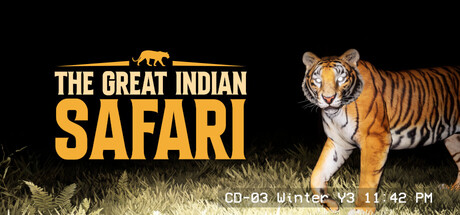
Eight plant species, five herbivores, four predators, arranged in a trophic pyramid that either works or doesn't. Sal and bamboo. Chital, sambar, gaur. Dhole packs that hunt together, a sloth bear that rips open termite mounds, and a Bengal tiger that only arrives once the reserve is mature enough to hold one.
Every animal runs its own decisions — hunger, thirst, fatigue, the predator upwind — and none of them consult you. You shape the habitat. The land does the rest, or it doesn't.
THE RESERVE PHOTOGRAPHS ITSELF
You never walk the forest and you never carry a camera. Your camera-trap network does. Place a trap, choose its facing, and every morning a contact sheet arrives with whatever walked past in the night — annotated by your ranger, paid for by the Department.
You can look at the forest whenever you like. You can only know it through the traps.
YOU'RE JUDGED ON WHAT YOU CAN PROVE
There are two counts of every animal in your reserve: the truth, which only the simulation sees, and the official books, which is what the Forest Department scores you on. Births and deaths never reach the books on their own. Only trap evidence does.
Thin coverage and your numbers read low. Worse: a reserve can read perfectly healthy on paper while its prey base collapses underneath it — right up until the census catches up and the numbers fall all at once.
OPEN THE GATES — WHEN YOU DECIDE
Nothing stops you opening on day one except the forest you'd be showing. Build a visitor network from paths, splitters and conditional routing. Sort five kinds of guest to the facilities they'll actually use. Run nature walks, jeeps, canters and elephant safaris, and let the reviews written at the exit tell you how it went.
This half of the game answers instantly and rewards optimisation. Then you find out every trip you add pushes the animals off the route you're selling. There's no layout that fixes this — only a rate of working the land that you choose and defend.
EVERY ANIMAL IS SOMEONE
Nineteen inherited traits, hidden recessives, and a memory each animal builds of its own reserve — where it fed well, where something nearly killed it, which trap it has learned to avoid. Breed for a rare line across generations. Follow one animal through its whole day. And watch for the three or four Named Legendaries whose first appearance is a half-glimpsed frame on a contact sheet, long before anyone sees them whole.
THEN THE NEIGHBOURS
The villages you founded for staff sit on the boundary, with crops and wells the wildlife has been eyeing since your first year. Elephants find the fields. Leopards find the livestock. Your endgame is being a good neighbour — with the same tools you've used all along.
FEATURES
- A systemic Indian wilderness — nine species, eight plant types, four seasons, no seasonal chores
- Camera traps that pay for evidence and correct the reserve's official record
- A photography mode with real focal length, focus and aperture — it scores nothing, and exists so you can look
- Genetic traits, spatial memory and Named Legendaries that make every animal an individual
- A visitor network you build, route and optimise — and a forest that pushes back
- Villages that supply your staff and become your Phase 3 problem
- 15 in-game years, 37 standing orders, 25–40 hours to a first victory
- No time-skip, no fertility purchase, no buying your way out of a bad season
- Every word the game speaks comes from inside it — a Forest Department letter, a ranger's report, a mentor's journal. No popups, no checklists

 Julkaisematon