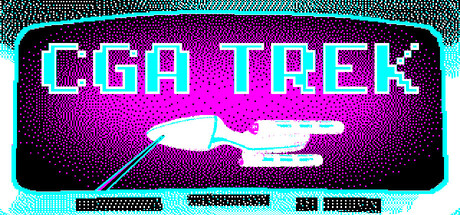
Cyan Alert! Set your eyeballs on stunned because it's time for CGA Trek! Your continuing mission is to seek out and destroy an invading fleet of warships in this modern homage to the classic turn-based strategy "Trek" game that originated on mainframe computers in the 1970s.
CGA Trek 上線人數與 Steam 圖表
即時
玩家人數024 小時 —
24 小時峰值玩家0今日最高樣本
30 天峰值玩家0平均 —
歷史峰值玩家0自開始追蹤以來
30 天遊玩時數—估計值
Steam 圖表 · 30 天玩家人數等待取樣中
正在收集每日樣本此遊戲尚未儲存任何每日樣本。累積最初幾天的歷史資料後,曲線就會出現。
24 小時—7 天—趨勢持平
評論11 篇評論
100.0%Positive
11 篇好評0 篇負評
推薦數—評分
媒體
7 張圖片
遊戲資訊
關於此遊戲
遊戲
發行日期2025年11月6日11 個月前發行
開發人員Classyk Games發行商Classyk Games類型動作策略冒險獨立
—成就—
關於此遊戲
玩家數更新於 9月18日 下午10:23 UTC · 商店資料更新於 9月22日 下午05:16 UTC · 來源:SteamWebAPI
最低配備建議配備作業系統Windows 10相同處理器2+ Cores, 2+ GHzAMD Ryzen™ 5 or better顯示卡2 GB VRAM, Vulkan 1.0 compatible hardware4 GB VRAM, NVIDIA GTX 970 or better記憶體2 GB RAM4 GB RAM儲存空間1 GB available space相同
關於 CGA Trek
Praise for CGA Trek
"An absolute masterpiece... I hate to say it may be the best thing you've ever done" -- SpaceGameJunkie
"Pure fun, that's gold these days" -- fernadolv3
"wow, the dialog, this is amazing, way beyond expectations" -- best luke
Introduction
Cyan Alert! Set your eyeballs on stunned because it's time for CGA Trek!
CGA Trek is a homage to the "Trek" game (sometimes known as Star Trek, Super Star Trek, Space War or Starkill) that originated on mainframe computers in the 1970s, inspired by the innovative PC version from the late 1980s called EGA Trek. Like Riker and his transporter clone Thomas, or Tuvix, it is simultaneously a demake and remake.
It aims to be a faithful recreation of the basic gameplay but in a modern, accessible, fun package. I wanted something with strong art direction so I picked the austere and beautiful 4-colour CGA palette of early 1980s computing.
Features
- Your very own starship equipped with many systems, including teletransmatporters.
- The alpha quadrant as an 8x8 grid containing 64 sectors.
- Each sector is an 8x8 grid of locations
- Starbases (general, research and weapon depots)
- Planets (with away missions)
- Enemy ships
- A scenario designer with five difficulty settings
- Authentic 1980s computer voice
- Great 8bit music
- Beautiful, beautiful CGA graphics - 4 colours - using the light magenta/light cyan palette at 320x200 resolution.
- A bunch of surprises for fans of the genre.
Let me know in the Steam forum if there are any accessibility tweaks I can provide to make this a great experience for you.
History
In 1971, Mike Mayfield wrote the game "Star Trek" for his local university's computer on punch tape. The game was designed to be played via a printer instead of screen.
In the 1970s, with no hard drives or floppy discs, code was often distributed in magazines and other publications. Hobbyists would read the code off paper and type it into their computer to play it.
It was this way that the code for "Star Trek" spread quickly in the computer world with variations and implementations popping up all over the place. One programmer wrote in the introduction to their version that "there have probably been more versions of this game written than any other as there is probably at least one version around for every type of computer ever made."
While the owners of the original 1960s Star Trek show gave written permission for those fan games to use elements of the TV series well into the 1970s (a decade when Star Trek was kept alive by the growing fandom) by the 1980s they appeared to have reduced this support. Jerry Pournelle (co-author of the excellent book The Mote In God's Eye - apparently also a computer nerd!) wrote in 1984 that his version of the game was renamed Star Kill after they "received a polite but insistent letter". (He also praised a variant of the game called "Star Fleet I", the sequel to which is available on Steam and is still being updated this this day).
Originally written in Sigma 7 BASIC, Trek was rewritten in many other dialects of BASIC such as HP BASIC and other languages such as FORTRAN.
It was a FORTRAN version of "Star Trek" that inspired Nels Anderson to write a version for the PC in around 1989. He upgraded the plain ASCII graphics to take advantage of new 16 colour hardware made by IBM called the Enhanced Graphics Adapter (EGA). EGA was a big upgrade over IBM's earlier Color Graphics Adapter (CGA) which effectively* did 4 colours.
The Anderson version of the game was titled "EGA Trek" and spread worldwide in the early 1990s as a great example of shareware. EGA Trek is often regarded as the best version of the genre.
While EGA was a big technological upgrade over CGA at the time, in some ways CGA has aged better. Its "weird" colour restrictions have given it a lot of personality compared to the more "normal" palettes of EGA. Additionally, the greater restrictions of CGA (fewer colours, lower resolution) can provide a lot of fun to game developers looking for a challenge. I hope you enjoy CGA Trek.
With massive apologies and much love to Nels Anderson.
* the actual colour capabilities of CGA and EGA are too complicated to fully summarise here but are popularly considered to be 4 vs 16 colours.

 排名 #117259