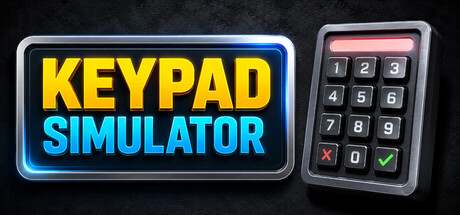
Try to guess a randomly generated 4-digit code on a keypad. It resets each day or when someone guesses it correctly. You only have one try each day. If you guess right, you earn a point.
MínimosRecomendadosSistemaWindows 10 or 11 64-bitigualCPUAny modern CPUigualGPUAny modern GPUigualRAM2000 MB RAMigualTamanho da transferência2000 MB available spaceigual
Acerca do jogo
Acerca de Keypad Simulator
There is a keypad next to a sturdy, metal door. You have to guess the passcode, and you only get one try per day. If you guess right, you earn a point. The code is the same for everyone and resets each day or with each successful guess. Earn as much points as possible!
- Features:
Randomly generated code (the same for all players)
- Sometimes random different sounds and weather
- Time of day effects (based on your local time)
The keypad is an input device consisting of a set of physical or touch-sensitive buttons used to enter numeric codes or simple commands. Keypads are commonly found wherever compact and reliable user input is required, particularly in access control systems, alarm panels, industrial machinery, and consumer electronics.
Door access systems employing numeric keypads became practical with the introduction of electronic access control during the 1960s, although mechanical push-button combination locks had already existed for several decades. These early electronic installations were primarily found in government facilities, research laboratories, offices, and industrial complexes where issuing physical keys to every employee was impractical.
Must security requirements change over time, keypad-controlled systems can usually be reprogrammed in minutes, eliminating the need to distribute new physical keys.
Not every keypad is intended for security. Similar devices are widely used in automated teller machines (ATMs), elevators, vending machines, calculators, telephones, safes, industrial control panels, and alarm systems, where their durability and simplicity make them a practical method of entering numerical information.
Be aware, that while considered exclusively a modern invention, mechanical push-button combination locks predate electronic keypads by several decades, although electronically controlled keypad entry systems first emerged during the 1960s before becoming widespread throughout commercial and industrial facilities during the 1970s and 1980s.
Opened by entering the correct numeric sequence, a keypad-controlled door grants access without requiring a physical key. This flexibility remains one of the principal advantages of keypad-based security, even as many contemporary systems now incorporate RFID cards, biometric authentication, or smartphone-based credentials.
Jogadores atualizados 19/09, 05:56 UTC · dados da loja 22/09, 08:11 UTC · fonte: SteamWebAPI
Keypad Simulator custa 2,36€ na loja Steam (DE). Neste momento tem 25% de desconto. O preço mais baixo que registámos desde 22/09/2026 é 2,36€. O Steam define preços diferentes para o jogo em 14 regiões — os preços regionais estão indicados acima.
Game Kiosk Digital lançou Keypad Simulator a 31 de julho de 2026. Lançado há 2 meses.
Mínimos: Windows 10 or 11 64-bit, Any modern CPU, Any modern GPU, 2000 MB RAM. O quadro de requisitos acima compara as especificações mínimas e recomendadas para cada plataforma.
O Steam indica 2000 MB de espaço livre em disco para Keypad Simulator.
100,0% das 6 análises do Steam são positivas — o Steam classifica-as como «6 user reviews».
Não — o Steam não inclui o português (Portugal) entre os idiomas de Keypad Simulator. No total, o Steam indica 1 idioma para Keypad Simulator, 1 com áudio completo.
Não — o Steam indica Keypad Simulator como um jogo para um jogador.
Os Steam charts de Keypad Simulator no SteamStatistics mostram os jogadores em direto e as curvas de 24 horas, 7 dias e 30 dias, atualizadas pelo menos a cada dez minutos.Abrir os Steam charts de Keypad Simulator ›
No Steam, Keypad Simulator funciona em Windows. Sem suporte para comando indicado.
Keypad Simulator tem a classificação DEJUS 10 e IGRS 18.

 Posição #128267