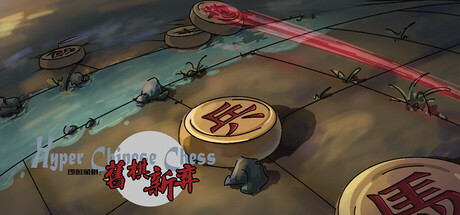
Turn-based play is central to Chinese Chess. HyperChineseChess removes this rule—battle AI or players in real-time, using quick thinking to win. Experience classic chess reimagined!
Jogadores de 即时象棋:旧棋新弈 Hyper Chinese Chess e Steam charts
A recolher amostras diáriasAinda não há amostras diárias guardadas para este jogo. A curva aparece assim que estiverem disponíveis os primeiros dias de histórico.
24 horas—7 dias—TendênciaEstável
Análises58 análises
79,3%Mostly Positive
46 positivas12 negativas
Recomendações
Multimédia
5 imagens
Detalhes do jogo
Acerca do jogo
Jogo
Data de lançamento6 de novembro de 2025Lançado há 11 meses
Conforto e áudioAdjustable DifficultyCustom Volume ControlsMouse Only Option
MaisTouch Only Option
Requisitos de sistema
MínimosRecomendadosSistemaWindows 7 SP1+ (64-bit)Windows 11 (64-bit)CPUIntel/AMD 2-cores 2.0 GHzIntel/AMD 4-cores 3.0 GHzGPUIntel HD Graphics 4000NVIDIA GeForce GT 1030RAM2 GB RAM4 GB RAMTamanho da transferência500 MB available space800 MB available space
Acerca de 即时象棋:旧棋新弈 Hyper Chinese Chess
Tired of traditional Chinese Chess? HyperChineseChess: Real-Time Battle – A Classic Reborn offers a fresh take! Face off against AI or challenge friends in real-time chess warfare. For extra thrills, try the Fog of War mode—where hidden moves intensify the clash!
In traditional Chinese Chess, players should obey the rules below.
The board consists of 9 horizontal and 10 vertical lines, divided by a "River" in the middle. Each side has a "Palace" (3×3 square with diagonal lines) at the center of the baseline.
32 pieces in total (16 per side): 将/帅 (General/King) ×1, 士 (Advisors) ×2, 相/象 (Elephants) ×2, 马 (Horses) ×2, 车 (Chariots) ×2, 炮 (Cannons) ×2, 兵/卒 (Soldiers/Pawns) ×5.
Red moves first, players alternate turns. Soldiers/Pawns cannot move backward.
The General (Black) or King (Red) is the core piece and can only move one square at a time (horizontally or vertically) within the Palace (3×3 grid).
Advisors move one square diagonally per turn and are confined to the Palace. They cannot step outside the Palace or move orthogonally.
Horses move like knights in chess (one square straight + one square diagonal). If the adjacent square in the initial direction is occupied ("hobbling the horse's leg"), the move is blocked.
Chariots move any number of squares horizontally or vertically (like a rook in chess), but cannot jump over pieces.
Cannons move like Chariots, but to capture, they must jump over exactly one intervening piece (called a "screen"). Without a screen, they cannot attack.
Soldiers move one square forward before crossing the River. After crossing, they can move sideways or forward, but never backward.
And this dynamic variant transforms traditional Chinese chess into an exciting real-time strategy game.
Players compete not in turns, but through continuous action point management. Each player gains 1 action point (AP) every second, stored up to a maximum of 4 AP. Every piece movement costs 1 AP, creating strategic decisions about when to save points and when to execute rapid maneuvers.
The core objective remains unchanged - checkmate the opponent's General. However, the real-time element introduces thrilling new dynamics. Players might choose to immediately spend AP on aggressive moves, or strategically save points for powerful combinations. The Cannon becomes particularly deadly when players accumulate enough AP to move and fire in quick succession.
All traditional movement rules apply: Generals stay within their palaces, Horses jump in L-shapes (unless blocked), Chariots roam freely, and Cannons require screens for captures. Soldiers gain mobility after crossing the river, but still cannot retreat. The key innovation is that players may move any piece at any time when they have AP available, leading to simultaneous actions and intense tactical exchanges.
Victory is achieved through the classic checkmate condition, but now under the pressure of real-time decision making. The AP system creates natural ebbs and flows in the game's tempo, rewarding both quick reflexes and long-term planning. Players must balance offense and defense while efficiently managing their precious action points in this fast-paced chess battle.
Perguntas frequentes
即时象棋:旧棋新弈 Hyper Chinese Chess custa 1,99€ na loja Steam (DE). O preço mais baixo que registámos desde 22/09/2026 é 1,99€. O Steam define preços diferentes para o jogo em 14 regiões — os preços regionais estão indicados acima.
上弦月工作室AscentGames lançou 即时象棋:旧棋新弈 Hyper Chinese Chess a 6 de novembro de 2025. Lançado há 11 meses.
Mínimos: Windows 7 SP1+ (64-bit), Intel/AMD 2-cores 2.0 GHz, Intel HD Graphics 4000, 2 GB RAM. O quadro de requisitos acima compara as especificações mínimas e recomendadas para cada plataforma.
O Steam indica 500 MB de espaço livre em disco para 即时象棋:旧棋新弈 Hyper Chinese Chess. Os requisitos recomendados pedem 800 MB.
79,3% das 58 análises do Steam são positivas — o Steam classifica-as como «Mostly Positive».
Não — o Steam não inclui o português (Portugal) entre os idiomas de 即时象棋:旧棋新弈 Hyper Chinese Chess. No total, o Steam indica 1 idioma para 即时象棋:旧棋新弈 Hyper Chinese Chess, nenhum com áudio completo.
Sim — segundo o Steam, 即时象棋:旧棋新弈 Hyper Chinese Chess tem PvP online.
Os Steam charts de 即时象棋:旧棋新弈 Hyper Chinese Chess no SteamStatistics mostram os jogadores em direto e as curvas de 24 horas, 7 dias e 30 dias, atualizadas pelo menos a cada dez minutos.
No Steam, 即时象棋:旧棋新弈 Hyper Chinese Chess funciona em Windows. Sem suporte para comando indicado.
即时象棋:旧棋新弈 Hyper Chinese Chess tem a classificação DEJUS 6 e IGRS 3.

 Posição #116289